Most homeowners assume that mold, musty odors, or excessive humidity are caused by a roof leak or plumbing problem. Many hidden indoor air quality problems are actually driven by something most people never think about: building pressure.
A home should function as a protective barrier between the indoor environment and the outdoors. When pressure becomes unbalanced, that protective barrier is compromised. Air naturally follows the path of least resistance, entering through openings that often remain hidden behind drywall, inside ceiling cavities, around electrical boxes, beneath sinks, behind toilets, around HVAC ductwork, and inside utility shafts.
In South Florida, this becomes especially important because outdoor air contains high levels of moisture for much of the year. When humid air is continuously pulled into concealed building cavities, condensation can develop on cooler surfaces. Over time, this combination of moisture, dust, and organic materials creates ideal conditions for microbial growth.
Pressure imbalances can also explain problems that many homeowners struggle to understand, including recurring mold after remediation, persistent musty odors, unusually high indoor humidity, rooms that never seem comfortable, or odors traveling between neighboring condominium units.
A Building Pressure & Air Leakage Assessment may be recommended if you experience:
These symptoms often point to underlying building performance issues rather than isolated mold problems. Understanding how air moves throughout a structure is frequently the first step toward identifying the true source of moisture intrusion.
Every Building Pressure & Air Leakage Assessment begins with a detailed visual inspection of the property, followed by an evaluation of the building envelope, HVAC system, moisture conditions, and potential air leakage pathways. We examine areas where unwanted air commonly enters the structure, including plumbing penetrations, electrical openings, utility chases, duct connections, attic access points, recessed lighting, ceiling penetrations, and other concealed openings that may contribute to pressure imbalance.
When appropriate, advanced diagnostic equipment such as thermal imaging cameras, moisture meters, hygrometers, particle counters, and differential pressure instruments are used to document conditions that cannot be identified during a visual inspection alone. Our goal is not only to locate existing moisture concerns but also to determine why those conditions developed and what factors continue to contribute to them.
By combining building science principles with professional diagnostic techniques, Home Enviro provides property owners with practical, evidence based recommendations designed to improve indoor air quality, reduce moisture intrusion, and support a healthier indoor environment.
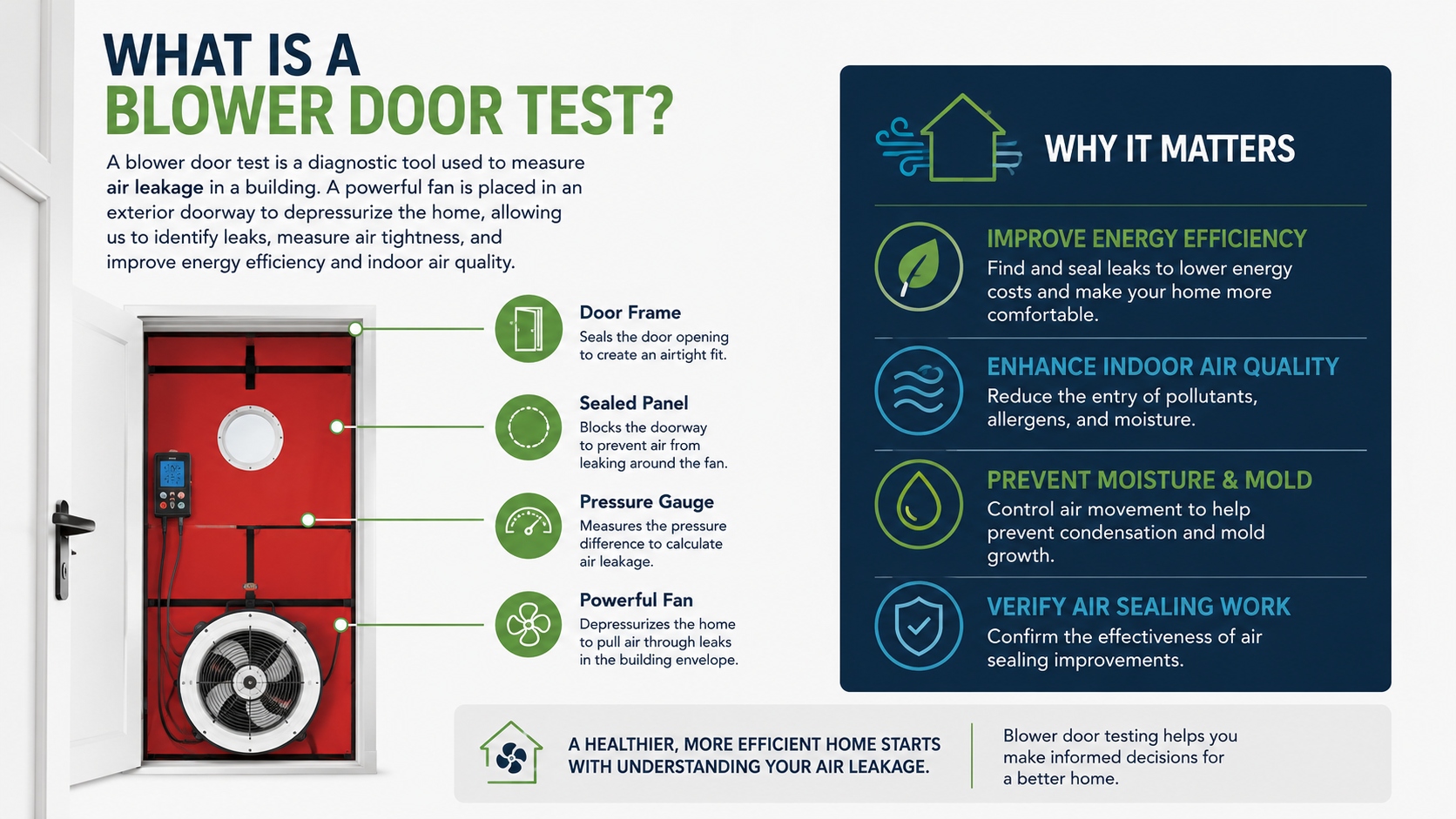
A complete pressure and air leakage assessment covers every pathway humid air can use to enter your home.
Pressure and duct leakage problems are invisible without the right instruments. We use calibrated, professional-grade equipment to quantify what a visual inspection alone cannot detect.
Pressurizes or depressurizes the duct system independently of the air handler to quantify exactly how much air is leaking as a percentage of total system airflow.
Measures pressure differentials between rooms, the building and the outside air, or a condo unit and its shared corridor, to identify negative or positive pressure imbalances.
Reveals temperature anomalies associated with air infiltration or trapped moisture behind finished surfaces that are invisible to the naked eye.
Confirms and quantifies elevated moisture content in framing, drywall, and other building materials near suspected leak points.
Tracks indoor relative humidity levels throughout the property to identify rooms or zones with abnormal moisture conditions.
When contamination is suspected, collects air samples for accredited laboratory analysis to determine whether indoor spore counts are elevated.
See how negative pressure and duct leakage create the conditions for hidden moisture and mold.
South Florida's climate keeps outdoor humidity high for most of the year, which means any pressure imbalance pulls in air that is already saturated with moisture. This makes pressure and duct leakage problems more consequential here than in drier climates, since infiltrating air is more likely to condense and support mold growth once inside a wall cavity or attic space.
Condominiums and multi-family buildings face an additional layer of complexity. Units share walls, corridors, and sometimes portions of the building's mechanical infrastructure. A unit running negative pressure, often due to a powerful bathroom exhaust fan with no dedicated makeup air, does not just pull in outside air — it can pull air from a neighboring unit or the shared hallway, carrying cooking odors, smoke, or humidity along with it.
Industry guidance for condominium HVAC design generally favors keeping individual units close to neutral, or very slightly positive, relative to shared corridors. When a unit is instead running negative due to duct leakage or unbalanced exhaust, odor transfer and moisture migration across shared walls become far more likely, which is why our assessment evaluates a unit's pressure relationship to neighboring spaces, not just its ductwork in isolation.
Ductwork rarely fails all at once — it degrades gradually at specific, predictable points, most of which are hidden above ceilings or inside attic spaces. A supply duct that leaks conditioned air into an unconditioned attic effectively removes air from the home without a matching return, driving the structure toward negative pressure. A return duct with a hole or a disconnected joint can pull hot, humid attic air directly into the airstream, distributing it through supply registers along with the conditioned air.
Common failure points include cracked mastic or degraded foil tape at joints and connections, disconnected flexible duct, crushed or punctured sections from attic foot traffic, poorly sealed boots and registers, and rooms with no dedicated return or transfer grille. Our assessment uses duct blaster testing to quantify leakage as a percentage of total system airflow and pinpoints whether the supply side, return side, or both are compromised.
If you have recurring mold after remediation, persistent musty odors with no obvious source, high indoor humidity despite a functioning AC system, or odors traveling between condominium units, a pressure and air leakage assessment is often more revealing than a standard visual mold inspection, because it identifies the mechanical cause rather than only the visible symptom.
No. Single-family homes are just as susceptible to negative pressure and duct leakage problems, especially homes with attic ductwork, multiple exhaust fans, or additions and renovations that altered the original HVAC design. Condominiums face additional complexity because units share walls and corridors, which is why we offer a dedicated section on condo pressure issues, but the core diagnostic process applies to any structure.
Most assessments take between 90 minutes and three hours depending on the size of the property and the complexity of the HVAC system. Larger homes, multi-zone systems, or properties with several reported problem areas may take longer.
No. Home Enviro performs inspection and diagnostic testing only. Florida Statute 468.8411 prohibits a licensed mold assessor from also performing remediation on the same property, and we uphold that separation strictly so our findings and recommendations remain independent and unbiased.
You will receive a written report documenting pressure and duct leakage measurements, thermal imaging findings, moisture readings, photographs of identified leak points, and clear recommendations for corrective action, formatted for use with contractors, HOA boards, or insurance carriers.
Home Enviro evaluates the entire property to identify all sources of mold and moisture, not just building pressure.
A focused inspection of your air conditioning system, including borescope evaluation of duct interiors and air sampling at supply and return registers. See the HVAC mold inspection service →
A complete assessment of every area of your property, including thermal imaging, moisture mapping, and a full written report. See the full mold inspection service →
Accredited laboratory air sampling to determine whether elevated mold spore levels are present indoors. Learn about air quality testing →
See the building science and research behind our inspection approach at Home Enviro. Visit Home Enviro →
Same-day appointments available throughout Broward, Palm Beach, and Miami-Dade. Licensed, independent — Home Enviro inspects only, never remediates.